
Most motorcycle badges tell you who made the machine. The FB Mondial badge also told you what the machine had won.
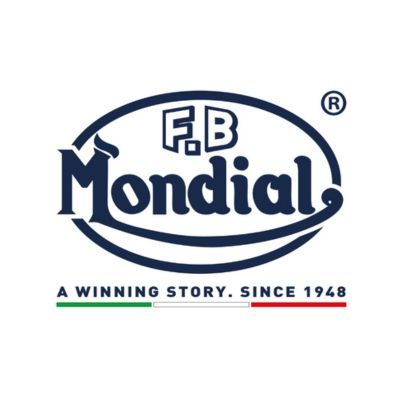
The core of it has hardly changed in more than seventy-five years: an oval, the initials F.B in squared capitals, and the word Mondial in a flowing script with a flame over the M and a long swash tail on the final l. What changed was everything around it. The oval switched between blue and red. A ribbon was added underneath, and the ribbon was a scoreboard: first "Campione del Mondo 1949-50-51", later "10 volte campione del mondo". For one season a globe appeared, carrying the flags of the 1957 champions. Then, in the early 1960s, the F.B disappeared, and it stayed away until the brand was revived in the 2010s.
This page follows the badge era by era, from the Boselli brothers' three-wheelers of the 1930s to today's Mondial. It is built on primary material where we could find it, including the tank transfers themselves, the brand's US trade mark filings, Honda's own account of the Mondial it bought, and the owners' register founded by the Boselli family. Where sources disagree we say so, and where the popular story is wrong, including on earlier versions of this page, we correct it. For the full company story, see our history of FB Mondial.
The Short Version
- 1929: The Boselli siblings found FB (Fratelli Boselli) in Milan, soon building three-wheeled goods vehicles in Bologna.
- 1930s: The company's marks are the initials F.B in squared capitals, with "Fratelli Boselli, Milano".
- 1948: The first racing motorcycle appears at Faenza wearing F.B Mondial on its tank: a large blue oval with no ribbon.
- 1949–51: Three consecutive 125cc world titles. From about 1951 the badge gains a striped ribbon reading "Campione del Mondo 1949-50-51".
- 1954–60: Red becomes the standard colour for the road bikes' oval.
- 1957–58: Double 125 and 250 world titles, then withdrawal from Grand Prix racing. A globe transfer celebrating 1957 appears on 1958 models.
- Early 1960s: The F.B drops out of the badge, and the ribbon changes to "10 volte campione del mondo".
- 1978–79: Production ends.
- 1990s–2000s: The family's company registers the script-in-oval without the F.B; the Piega 1000 superbike is revived under the name Mondial.
- 2014–15: Under licence to Pelpi International, the brand returns as FB Mondial, with the F.B back in the oval.
1929–1947: Fratelli Boselli
The FB in FB Mondial is not a person. It stands for Fratelli Boselli, the Boselli brothers, and Italian sources agree that the company was founded under the name FB in Milan in 1929. (A few accounts give 1936, the date of the earliest surviving brochure, or say the company began after the war. The 1929 date is the best supported.)
The Bosellis were a landowning family from Piacenza. The Italian Wikipedia and several Italian motoring titles name five siblings, Carlo, Luigi, Ettore, Giuseppe and their sister Ada, although other accounts speak of Giuseppe and "his brothers" in different numbers. Giuseppe Boselli, a competition rider who was also part-owner of the Bologna motorcycle maker G.D., was the driving force.
The business began as a shop and workshop in Milan selling and servicing G.D. motorcycles. It then built motocarri, three-wheeled goods vehicles, in Bologna, where it worked with the engineer Oreste Drusiani. The Bologna works were bombed in 1943 and the company regrouped in Milan.
Nothing from these years says Mondial. The mark was the initials. A 1936 brochure, reproduced by the Cybermotorcycle archive from the collection Moto di Lombardia, is headed "MOTOTRASPORTI F.B – F.lli BOSELLI – MILANO", and it celebrates first prize at the first National Motor Transport Competition in Milan on 16 January 1936. Another carries a company logo of large outlined F.B initials above a box reading "BOSELLI", with "Fratelli" to one side and "Milano" to the other.
Those squared, outlined initials matter, because the same style of lettering later sits above the Mondial script. No written source says the post-war designers took them from the motocarri, but the resemblance is clear to anyone who puts the two side by side.
1948–1950: F.B Mondial Goes Racing
After the war the Bosellis moved from goods vehicles to motorcycles, and they did it by racing. Giuseppe Boselli commissioned Alfonso Drusiani to design a twin-cam 125cc single. In October 1948, with Luigi Cavanna riding, the machine set four world records.
The new name went with the new product. According to the Italian motorcycling federation (FMI), the racer made its debut "with the F.B. Mondial mark on the tank", and Motorcycle Classics dates the first appearance of the Mondial logo on a motorcycle to 1948. The debut race was the Nations Grand Prix at Faenza on 12 September 1948, where Francesco Lama set the fastest lap before retiring.
Why "Mondial"? It is the French for "worldwide". No source from the period explains the choice. Italian writers describe it as an auspicious name (il marchio augurale Mondial), and it proved an accurate one, but the popular story that it was chosen to commemorate the 1948 world records is not supported by any source we have found.
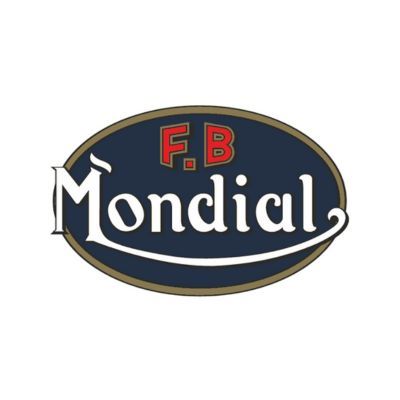
The first badge. The earliest racers carried a large dark-blue oval with no ribbon beneath it. The source for this is unusually good. In 2019, an owner asked the Registro Internazionale FB Mondial, the owners' register set up by the Boselli family, why some 1950s badges were blue and some red. The reply, signed by Piero Boselli, begins: "i badge red erano la regola" (red badges were the rule), and adds that "the very first racing bikes had larger blue ones without the 'Campione del Mondo' wording underneath."
The elements of the design were already in place:
- F.B in squared, outlined gold capitals;
- Mondial in a white script, with a flame-like flourish on the capital M that reads almost like a grave accent over the o ("Mòndial");
- a long swash on the final l that sweeps back beneath the word;
- all of it on an oval with a thin gold border.
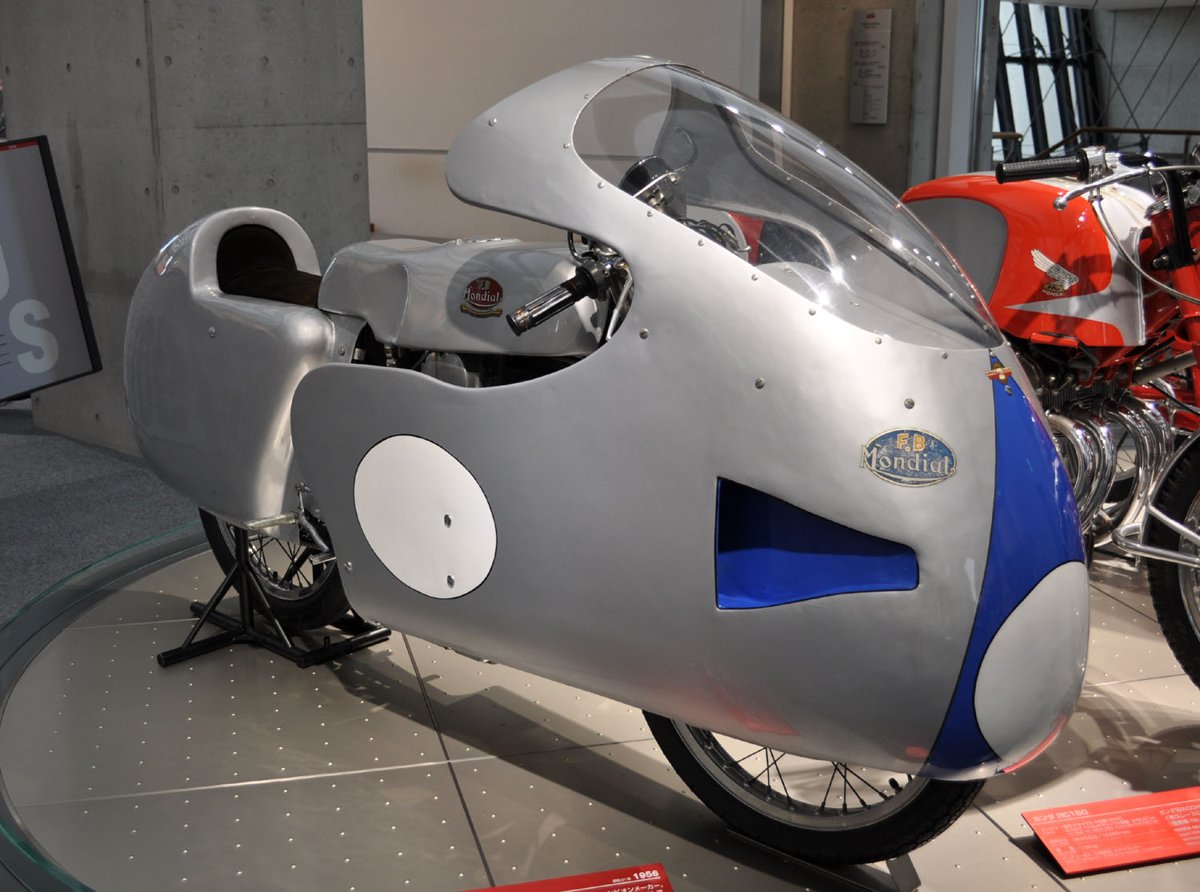
On the works racers the badge sat against silver bodywork, often with blue panels, and silver-and-blue became the look of Mondial's Grand Prix machines.
1951–1960: The Ribbon That Kept Score
Mondial won the first three 125cc world championships: Nello Pagani in 1949, Bruno Ruffo in 1950 and Carlo Ubbiali in 1951. (Mondial's own history page says Ubbiali won "for a third consecutive year". It was Mondial's third consecutive title, and Ubbiali's first.)
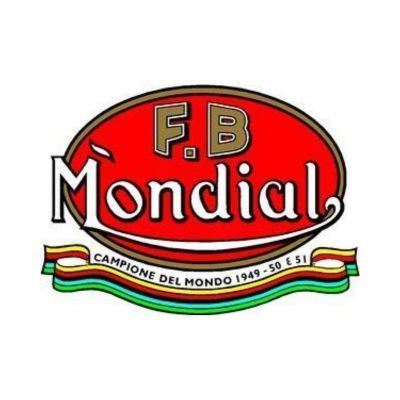
The badge started to say so. A striped ribbon in yellow, red, blue and green was added beneath the oval, reading "CAMPIONE DEL MONDO 1949-50-51", and this is the version most people picture when they think of a classic Mondial. The Registro's reproduction transfer sheets date it as follows:
- 1951–53: blue or light-blue ("azzurro") oval with the 1949-50-51 ribbon, for the 125, 160 and 200 with pressed-steel forks;
- 1954–60: the same design in red, "on all Mondials from 1954 to 1960", with two large transfers for the tank and small ones for the mudguards and toolbox.
The Registro's reply adds some exceptions: light-blue ovals on the first 160s and some 50cc Sport models, and on the earliest 175 Super Turismo, a red oval without the F.B and with a differently drawn accent.
These were water-slide transfers, not metal badges. They were fragile, which is why so many surviving examples are worn, and why so many restored bikes wear reproductions.
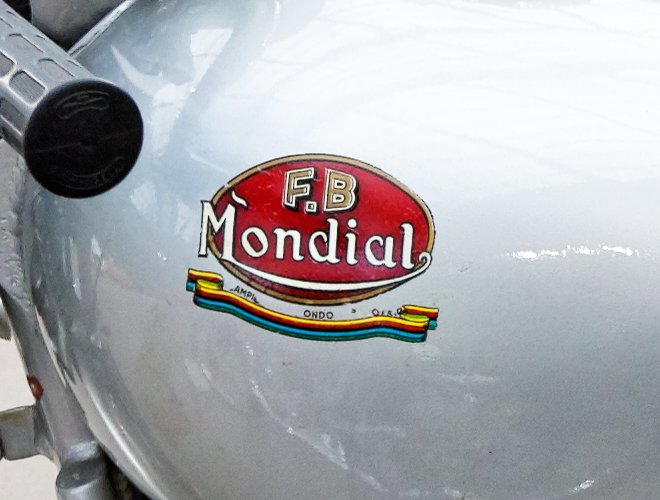
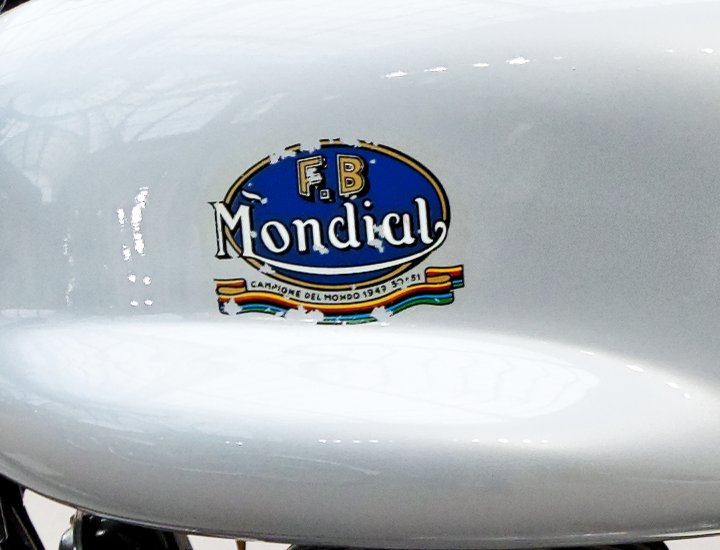
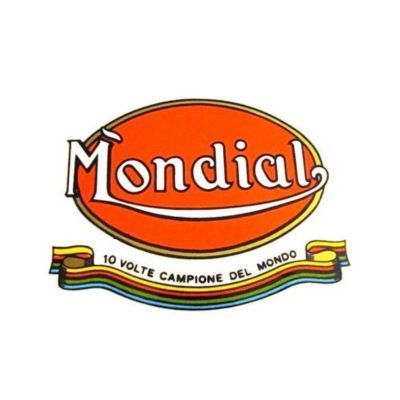
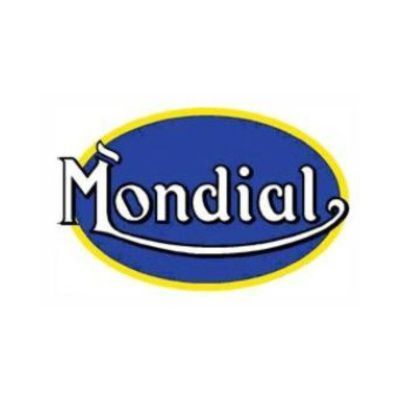
Look closely at those two photographs and you can see why dating Mondials by their transfers is tricky. The red one is on a bike catalogued as 1949, yet its ribbon celebrates 1951; a bike from 1949 could not have left the factory with it, so either the date is approximate or the transfer was applied later. The blue one is on a 1957 175 Super Turismo, when by the Registro's dating red was the rule and early Super Turismos had no F.B at all. Neither is necessarily wrong as a restoration, but neither proves what the factory fitted.
1955–1958: Laurels and a Globe
As the wins mounted, Mondial added more transfers. The Registro's sheets list:
- "VINCITRICE ASSOLUTA Giro d'Italia – Milano e Taranto 1954", a gold panel with Italian tricolours for the 1955 forks, celebrating road-race wins.
- Laurel wreaths reading "125 cc. Campione d'Italia 1955", for the 125 Champion of 1956–57.
- Laurel-wreath numbers for the Scugnizzo 75, 88 and 98, and the 175 "Campione d'Italia 1956".
Then came Mondial's best year. In 1957 Tarquinio Provini won the 125cc world championship and Cecil Sandford the 250cc, and the factory celebrated with its most elaborate transfer: a globe (mappamondo) with a ribbon carrying the Union Jack and the Italian tricolour, the words "CAMPIONE DEL MONDO 125-250 1957", and a rim listing national titles: champion of Peru, Great Britain (125 and 250) and Italy, and motocross champion in the 250 and 500 classes. It was used on the 125 Champion and the 175 of 1958, two per tank, with flag strips on the forks.
The flags match the two 1957 champions, an Italian and a Briton. The globe also answers a question that comes up about the Mondial logo: yes, there was a Mondial globe, but it was a one-season championship transfer, not the brand's logo.
At the end of 1957 Mondial withdrew from Grand Prix racing along with Gilera and Moto Guzzi, in a joint announcement known in Italy as the patto di astensione ("abstention pact"); the full story is in our history of FB Mondial. The ribbon had one more change to record.
Early 1960s–1978: Mondial Without the FB
In the early 1960s the badge lost its initials. In the words of the Registro's reply: "Dai primi anni 60 è sparito l'FB e sotto è finalmente apparsa quella '10 volte campione del mondo'" (from the early 1960s the FB disappeared, and underneath at last appeared "10 times world champion").
Why ten? Mondial won five riders' titles (1949, 1950, 1951, and the 125 and 250 in 1957) and five manufacturers' titles. Five plus five makes ten, and the brand has used "10 volte campione del mondo" ever since.
When exactly? The Registro gives two dates. One reproduction sheet says the no-FB transfer is for "all Mondials from 1961 onwards"; its decal page says "almost all models produced from 1964 onwards". Both place it in the early 1960s. Red remained the usual colour, with blue versions also made.
Other marks of the period, again from the Registro's sheets:
- Mondial 50, first series: laurel badges reading "42 volte campione d'Italia / 10 volte campione del mondo / 10 volte campione di Francia" (1963–64), later "11 volte" (1965–69), and from 1970 "50 volte campione d'Italia… 15 volte campione di Francia".
- Nova (from 1961): an italic red "Mondial" on a striped banner.
- Mini (1967–71): its own zig-zag "mini" lettering.
- 1970s: plain block MONDIAL capitals on some 50cc and 125cc models.
Giuseppe Boselli stepped back in 1965 for health reasons, handing over to his nephew Massimo. The business shrank; later models used bought-in engines, and production stopped in 1978 (some sources say 1979). The company itself, Mondial Moto s.r.l., survived, and it still owned the name.
1995–2013: Mondial, Registered and Revived
With no bikes being built, the Mondial name became a legal asset, and the trade mark records show what the family chose to protect.
In April 1995, Mondial Moto s.r.l. of Milan filed a US application for the word MONDIAL for motorcycles (serial 74660093, registered in November 1998). The drawing is the Mondial script, with its flame and swash, inside an outline oval, without the F.B. That was the 1960s form, not the 1950s one. Later US filings, in 2004 and 2006, used the same script reversed out of a solid oval; both were abandoned, one after an opposition. In Europe, Mondial Moto Srl holds an EU registration for "Mondial", which it says covers the name "F.B. Mondial" too.
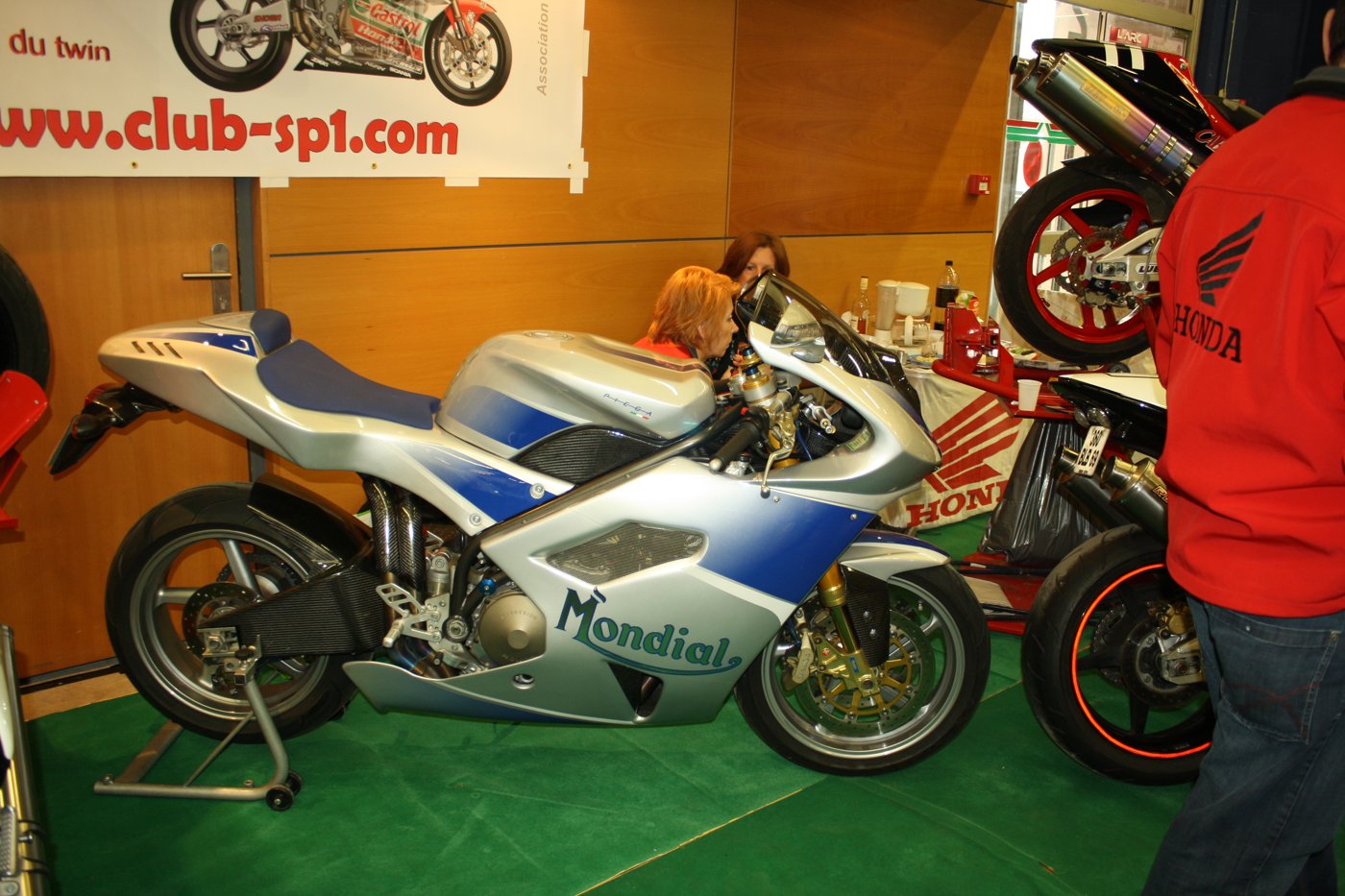
The Piega. In 1999 the Boselli family licensed the name to a new company, Mondial Moto S.p.A. of Manerbio, near Brescia, backed by Roberto Ziletti, head of the Lastra printing-plate group. (Some English sources call him a newspaper tycoon; Lastra made printing plates.) Its product was the Piega, a superbike powered by the V-twin from Honda's VTR1000 SP-1. It was styled with a silver and blue livery that echoed the old racers and carried the "Mondial" script on its fairing, without an oval and without the F.B. As one Australian writer noted, the maker was "Mondial Moto SpA, notably not F.B. Mondial."
The Honda engine deal is usually told as Honda repaying a debt, and there is a real story behind it. Honda's own heritage site records that in September 1958 its racing team "acquired an Italian production racing machine. It was a 125 cc F.B. Mondial… a 1956 model", and that studying it helped Honda build its first Isle of Man TT racer. (Honda says a 1956 model; accounts calling it a "1957 championship-winning" bike, or a gift from Giuseppe Boselli, go further than Honda does.) The machine is displayed at the Honda Collection Hall at Motegi. Whether gratitude actually shaped Honda's decision to supply the Piega engine is not something Honda has said.
Mondial Moto S.p.A. failed in 2004 after building a small number of Piegas; estimates range from about 76 to 155. Its assets passed to Gruppo Mondial, formed by Piero Caronni in 2005, which assembled more, before that venture too faded.
2014–Present: The FB Comes Back
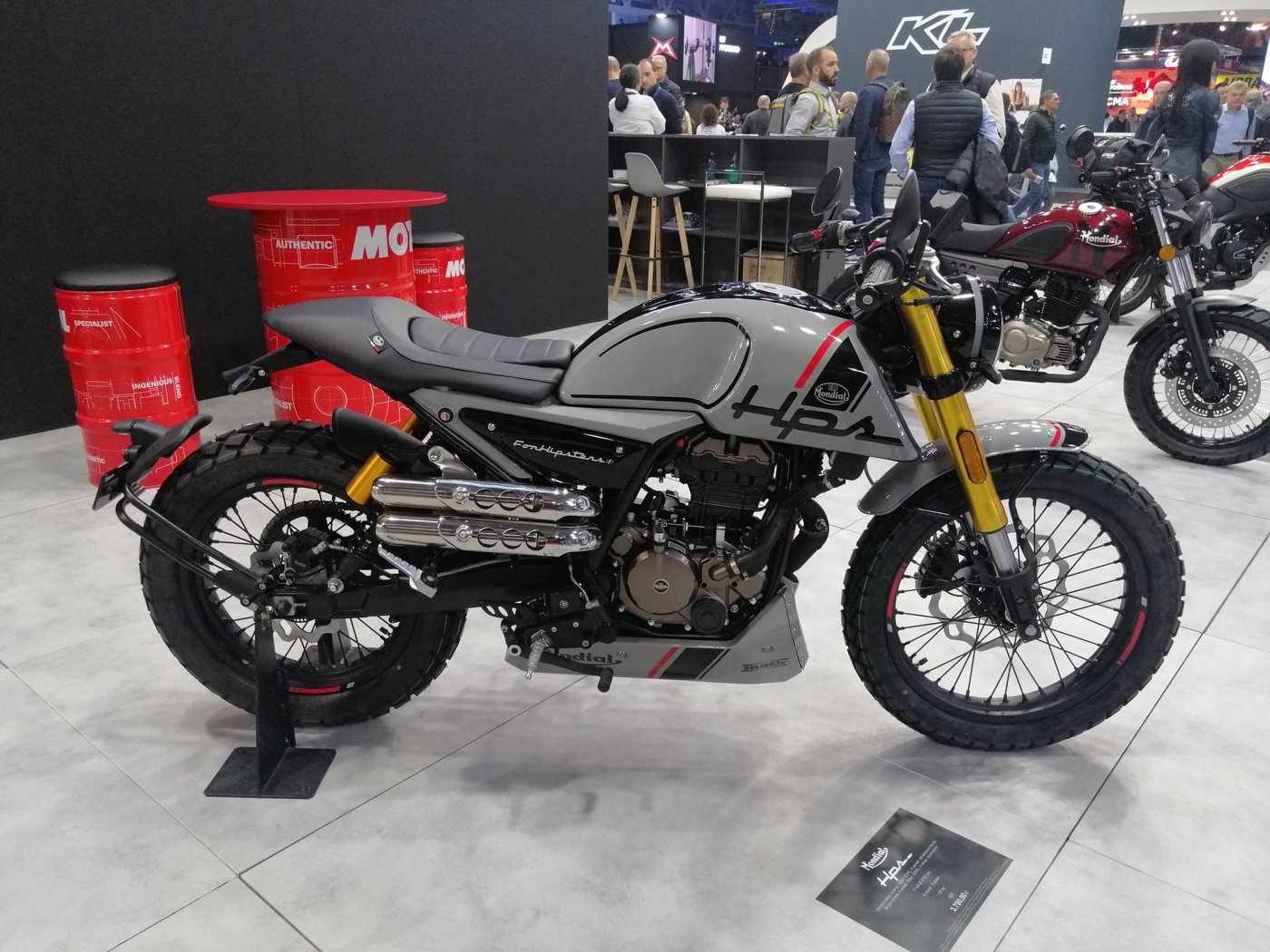
In 2014, Count Pierluigi Boselli, a descendant of the founders whose company Mondial Moto Srl still held the trade mark, licensed the brand to Cesare Galli's Pelpi International, based near Como. The first new model, the HPS 125, was unveiled at the EICMA show in Milan in November 2015, with a Piaggio-group engine. As New Atlas put it, it was "great to see the Mondial logo back on the tank of a production motorcycle."
This time the initials came back. The current logo is the 1950s badge, redrawn:
- an outline oval, usually in a single colour (navy, black or white) rather than a solid red or blue fill;
- the F.B in squared capitals with an inline, above
- the Mondial script, still with the flame over the M and the swash under the final l;
- a registered-trade-mark symbol.
The ribbon is gone from the core logo. In the full brand lockup, the tagline "A Winning Story. Since 1948" sits beneath, over a thin green, white and red rule. On the bikes the badge is usually applied small and in a single colour: on the 2025 HPS it is a monochrome oval on a grey tank.
Who owns the mark? In 2018 Mondial Moto Srl publicly stated that it was the sole owner of the "F.B. Mondial" trade mark, with Pelpi International as exclusive licensee, after the EU trade mark office rejected an application for "Mondial Moto" by an unrelated company. Some recent Italian coverage calls Pelpi the owner; we have found no record of a transfer. The current range includes the Pagani, Flat Track and SMX lines and the 452cc Piega, the name reused from the Honda-engined superbike.
Lettering and Colour
The script is custom. The Mondial script, with its flame over the M and the swash under the l, is hand-drawn lettering, not a typeface; its registered form is the trade mark drawing. No designer has ever been credited for any version of the Mondial logo, and we have not found one.
The colours are not symbolic. The Registro treats colour as a matter of model and batch: red "was the rule", blue went on the first racers and early bikes with pressed-steel forks, and light blue on a few specific models. The ribbon's bright stripes resemble the rainbow bands of a world champion's jersey, which suits the words written on it, but no source says that was the intent. Any website telling you that Mondial red stands for passion is guessing.
How to Date a Mondial by Its Transfers
This table is drawn from the Registro Internazionale FB Mondial's reproduction transfer sheets and its published replies to owners. Treat it as a first check, not a verdict: Mondial was a small factory, exceptions were common, and many surviving bikes have been restored with whatever transfers were available.
| Period | Badge | Typical models |
|---|---|---|
| 1948–c.1950 | Large blue F.B Mondial oval, no ribbon | Works racers |
| c.1951–53 | Blue or light-blue F.B oval, "Campione del Mondo 1949-50-51" ribbon | 125, 160, 200 with pressed-steel forks |
| 1954–60 | Red F.B oval, same ribbon | Most road models |
| 1955 | "Vincitrice assoluta Giro d'Italia 1954" panel | 1955 forks |
| 1956–57 | Laurel wreath, "125 cc. Campione d'Italia 1955" | 125 Champion |
| 1958 | Globe transfer, "Campione del Mondo 125-250 1957" | 125 Champion, 175 |
| Early 1960s–1970s | Red (or blue) Mondial oval, no F.B, "10 volte campione del mondo" ribbon | Most models from 1961 or 1964 on |
| 1961 on | Italic red "Mondial" on a striped banner | Nova |
| 1963–70s | Laurel badges counting Italian, world and French titles | Mondial 50 |
| 1970s | Block "MONDIAL" capitals | Some 50 and 125 models |
Red flags:
- An F.B oval on a model built after the mid-1960s, or a "10 volte" ribbon on a bike from the 1950s.
- A "1949-50-51" ribbon on a bike claimed to be original from 1949 or 1950.
- Decals from the other Mondials. Turkey's Mondial (Uğur Motorlu Araçlar, since 2004) and Argentina's Mondial Motos are unrelated brands with their own logos, and the blue "M in a circle" logo filed on Wikimedia Commons as "Mondial logo" is the Turkish company's.
Reproduction transfers made from original sheets are available through the Registro Internazionale FB Mondial. For current prices by model, see our FB Mondial valuations.
What the Logo Stories Get Wrong
| Claim | The evidence |
|---|---|
| "FB was the founder's initials." | FB stands for Fratelli Boselli, the Boselli brothers. |
| "Mondial was named for its 1948 world records." | No source from the period explains the name; "Mondial" is simply French for "worldwide". |
| "The Mondial logo is a globe." | The globe was a 1958 transfer celebrating the 1957 titles, not the logo. |
| "Honda received Mondial's 1957 championship-winning bike." | Honda's own history says it acquired a 1956-model 125 in September 1958. |
| "The Piega used an Aprilia engine." | It used Honda's VTR1000 SP-1 V-twin. |
| "The badge always read FB Mondial." | From the early 1960s until the 2010s the badge read Mondial alone, and the family registered it that way. |
| "Ubbiali won three titles in a row for Mondial." | Mondial won three in a row (1949–51); Ubbiali's was the 1951 title. |
| "FB Mondial is owned by Aeon Motors of Taiwan." | We found no support for this. The trade mark is held by the Boselli family's Mondial Moto Srl and licensed to Pelpi International. |
FB Mondial Logo Timeline
The Boselli siblings found FB (Fratelli Boselli) in Milan.
FB motocarri brochures carry squared "F.B" initials with "Fratelli Boselli, Milano".
The 125 twin-cam racer debuts at Faenza on 12 September with "F.B Mondial" on its tank.
Three consecutive 125cc world titles; the "Campione del Mondo 1949-50-51" ribbon appears.
Red becomes the standard colour of the road bikes' oval.
Provini (125) and Sandford (250) win world titles; Mondial withdraws from Grand Prix racing.
The globe transfer celebrates the 1957 double. Honda acquires a 1956 Mondial 125 racer in September.
The F.B disappears and the ribbon reads "10 volte campione del mondo".
Motorcycle production ends.
Mondial Moto s.r.l. files a US trade mark for the Mondial script in an oval, without the F.B.
The Honda-engined Piega revives the name as "Mondial".
The brand is licensed to Pelpi International; the HPS 125 launches at EICMA 2015 with the F.B back in the oval.
FB Mondial Logo FAQ
What does FB stand for in FB Mondial?
Fratelli Boselli, meaning "the Boselli brothers". The Boselli siblings founded the company in Milan in 1929, and it traded as FB before it built its first Mondial motorcycles in 1948.
What does Mondial mean?
"Mondial" is French for "worldwide". The company never explained the choice in any source we have found; Italian writers describe it as an auspicious name, and Mondial went on to win ten world championships.
What does '10 volte campione del mondo' mean on the Mondial badge?
"Ten times world champion". Mondial won five riders' world titles (the 125cc class in 1949, 1950, 1951 and 1957, and the 250cc class in 1957) and five manufacturers' titles. The wording appeared on the badge's ribbon from the early 1960s.
Why are some Mondial badges blue and others red?
According to the owners' register founded by the Boselli family, red was the standard colour. Blue was used on the first racers and on early road bikes with pressed-steel forks, and light blue on a few models such as the first 160s. The colours do not carry any documented meaning.
Why did the FB disappear from the Mondial logo?
No source records the reason, but the change is well documented: from the early 1960s the badge read "Mondial" alone, and the family registered the name that way in the 1990s. The F.B returned when the brand was revived in 2014–15.
Who owns the FB Mondial brand today?
The trade mark is held by Mondial Moto Srl, the company of Count Pierluigi Boselli, a descendant of the founders. Since 2014 it has been licensed exclusively to Pelpi International, which designs and sells the current FB Mondial range.
Sources
- Registro Internazionale FB Mondial (the Boselli family's owners' register): reply on transfer colours, 1 May 2019, and reproduction transfer sheets
- Honda, The 1958 Isle of Man TT race (the 1956 Mondial 125 Honda acquired)
- Federazione Motociclistica Italiana, Mondial, un marchio straordinario
- Italian Wikipedia, Mondial Moto; English Wikipedia, FB Mondial
- Dueruote, Tributo Mondial: storia di un marchio italiano
- inSella, Mondial brand history and Mondial Moto, chiarezza sul marchio (2018 trade mark statement)
- Corsedimoto, Mondial, pluricampione 125cc e 250cc
- Moto.it, Mondial, un registro storico per il marchio 10 volte campione del mondo
- Motorcycle Classics, 1957 Mondial 250GP
- Cybermotorcycle, F.B. Boselli (1930s brochures)
- USPTO, trade mark serials 74660093 and 76624206
- OddBike, Mondial Piega: honouring a favour; MCNews, The F.B. Mondial 1000 Piega
- New Atlas, FB Mondial 125 and 250; FB Mondial, History
Read the full history of FB Mondial, browse FB Mondial models and values, or compare with the badge stories of Ducati, Benelli and Moto Guzzi.